Wednesday, July 28, 2021

New Mexico Trip, Chapter 3: Ghost Towns of San Miguel County

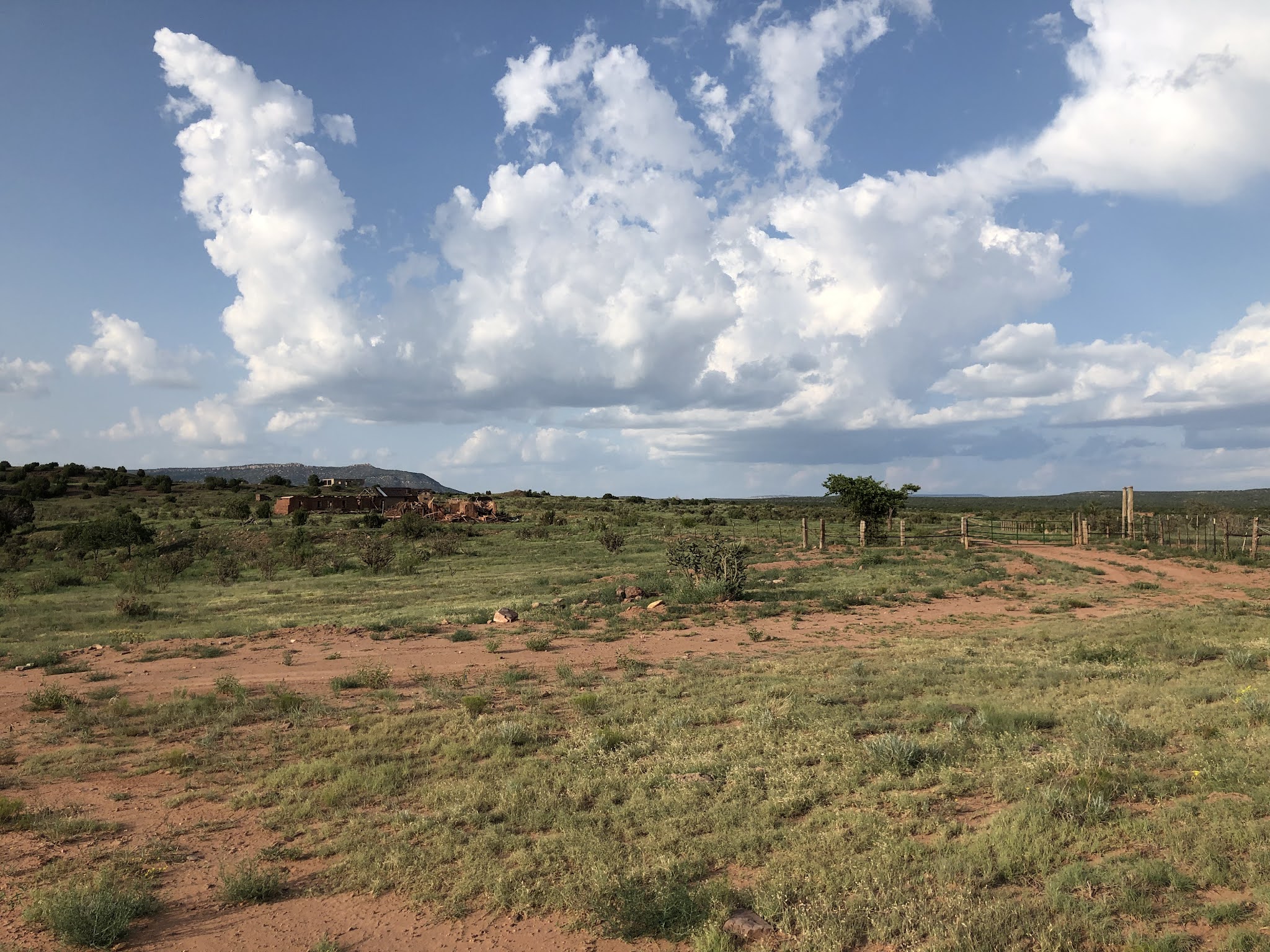
Is this not beautiful country?  New Mexico captured my heart many years ago and never fails to recapture it.  This is the road--such as it is--to an abandoned town that I dare not name.  The nearest hill is known as Mesa Lauriano.
Exploring this ghost-town was the highlight of my week-long trip out West.  And yet, I cannot tell the name of this place because it would be a betrayal to the friendly cowboy who gave us permission to visit this place.  
This old town site is extremely isolated, deep inside a very large private ranch.  Two young cowboys found me inspecting the chained gate leading into the ranch, and they kindly gave me the phone number of the ranch manager.  These broad vistas and striking views are reserved for ranch hands and cowpokes...and cows, of course.
But with a lot of persistence and the right map, you'll find the ancient Spanish settlement, some of which is surprisingly still intact.  It's a five mile walk from the last cattle guard, and take careful note of the trail you take because it's possible to get lost on your way back.  My friend and I did...and you should have heard him moaning about it....
With a roof, this old house would still offer shelter from the elements.
One house had an old tin ceiling collapsing into one of its two rooms.
Click on this photo to enlarge it.  There are several homes visible here.
The road into this place is barely visible even by daylight, but people were still traveling it as recently as the early 2000s in order to visit loved ones in the village cemetery--which we never found.
We did meet a few reptilian friends along the way, like this horny toad.
My friend nearly stepped on this rattlesnake on the long trudge home--as we frantically looked for traces that we had passed along that same road on the way to the town.  We may or may not have gotten slightly lost, or at least confused about our route, on the way back to the campsite.

And this little fellow was the only one home when we visited one of the larger houses in the village.
This is the first building you see in the town, approaching from the north.
Click on this photo to see the window in the middle where the old wooden latticework is still partly intact.
The tufted clouds above complement the tufted ground below.
This particular town has all sorts of artifacts on the ground outside the buildings.  Old pieces of broken glass.  Shards of patterned china.  Old hardware, tools, and bits of unknown paraphernalia.
When these adobe bricks erode, they simply return to the earth--which is how buildings ought to be: biodegradable.
See the bare ribcage of a long-gone roof above this otherwise sturdy stone house, with similarly shaped mountains in the distance.  The architecture here seems to rise right out of the earth, and it returns into the earth so gracefully.
One of the handsomest structures in town was probably once a mechanic's shop where cars were repaired.  Look at the excellent stonework.
Once again, the stone-laying is perfect--crisp, even, straight, and tight--and yet entirely without mortar.  It makes use of a variety of stone sizes, and colors, and shapes to create a beautiful composition of stonework.  At first glance, it's simple and easy to overlook.  At second glance, every simple two-room house is a work of art--deceptively intricate in its stony design.
My favorite building was this little homestead.  Some of the paneled wooden doors were still standing in their doorways.  Ceilings, floors, and walls were still solid--probably due to its good roof.
Here's the interior.  This house was almost entirely intact, aside from broken windows and a whole lot of crud.  Clean it up, close up the windows, and it could be a home again.
From a distance, the barn, ranch house, and corral here seemed like they were still in use.  This is the newest architecture in town, and the windmill in the background just keeps pumping away in the dry western wind.
The ranch manager told us that the last inhabitant left the town in 1982--though most left before that time.  I'm pretty sure this little white ranch house is where that last townsperson lived.  Click on this photo to see the rusty can of Dinty Moore beef stew on the counter with another in the cupboard.  It was probably an overnight shelter for cowhands.
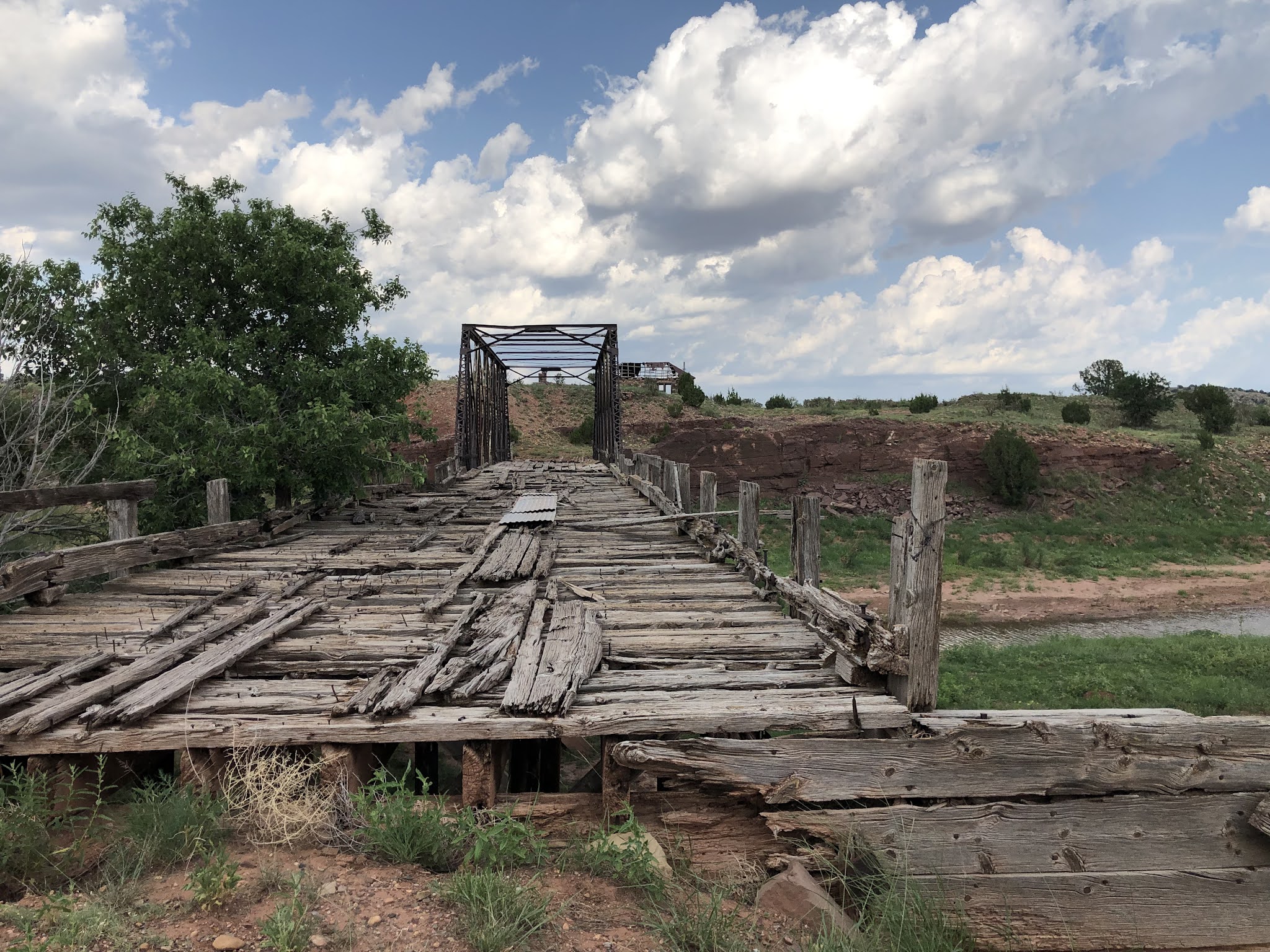
But the town's crowning glory is its crumbling bridge across the Gallinas River! 
And I use the term "river" lightly.  It's more a string of stagnant mud puddles.  Here's the bridge and the river as seen from above.
Some interior shots...
A room with a view.
I would happily live here, wouldn't you?
This building was large and low with two very big rooms.  I'm guessing it was once a barn.
We never did find the cemetery that belongs to this town--and all these old ghost-towns have charming cemeteries filled with humble gravestones etched with simple Spanish folk art.  But there were plenty of open water wells, most of them dry as dust and plenty dangerous.  We almost took the wrong road on the way back to our campsite, 5 miles away, and had a very anxious march back to our tent.  "Is this the right road?  I don't know.  Do you see our footprints headed the other direction?  I don't think so."  Ah, but we made it back alright.  The moon came up full and glorious, and it lit the cool night with a glory I've rarely known.  The Buck Moon, my friend's wife called it.

New Mexico Trip, Chapter 2: Ghost Towns of San Miguel County

I cannot tell you the name of this most excellent ghost-town because it's on private property, and I may or may not have ventured there unbeknownst to the owner.  Now, hear me well!  The editorial board of Snow and Jaggers in no-wise encourages or condones trespassing.  But this area--although fenced for cattle--was not posted.  So it's officially a gray area.  Plus, this place has been on my ghost-town wishlist for DECADES, and it always appeared very unwelcoming in the past.  Just incidentally, the maximum punishment for trespassing in New Mexico is a $1,000 fine.
Of course, if I had trespassed in this beautiful place, I'd have done it respectfully and even reverently, taking great care to leave this venerable old Spanish settlement exactly as I found it.  Here's the mostly dry bed of Trementina Creek as it passes between cottonwoods through the dusty town site.  
A view from the inside of a ruined house.
A very large house in the town.  It looked as if rooms were added slowly as adult children got married and brought their own families under the roof to live.
Look at the sharp corners and the straight alignment of these old walls.  They're lovely old works of folk art, really.  Not a drop of mortar, not a speck of cement.  They're just beautifully cut and stacked to form a visually satisfying little structure.
Junipers have overtaken much of the old town.
Here again is the valley of the mostly dry creek bed, as seen from above.  The grassy vale is pleasant and green but buzzing with horseflies, which pack a very mean bite.  It stings.  My friend cursed and moaned.  He loved to voice his loud protestations about the unfairness of it all--because the horseflies seemed much more interested in him than in me.  You'll see an old electric line in the sky above the valley.  That's one clue that there was once a town at this spot: an electric line ends here.
The sluggish creek from below.
Look again at the lovely evenness of these ancient walls--where not a bit of mortar was used.
The mesa in the distance shares the same name as the creek.  I liked this view.
This one, too.
Many of these old walls served as cattle corrals, I think.  Or maybe sheep pens?  In any case, see how much less carefully laid the stones are--how less shapely and even the walls?  
Looking out another window.  The wooden lintel above this one has long since collapsed.  Parts of these old walls still had adobe stuck to them--which explains their unevenness; these stones were never meant to be seen.
The largest house we saw in the village.  It showed signs of once having had electricity and maybe even some basic plumbing.
Who lived here?  What were their lives like?  To think that children were born here, and children died.  People of all ages lived out their span of years in this place, regular years filled with toil, and pain, and hope, and joy.  The room pictured here, what did it see in its day?  Hours and hours of sleeping, and talking, and love-making, perhaps acts of cruelty and acts of courage and strength?  We will never know.  Its secrets have passed into the deathless mind of God.  
What did it take to make a living in such an inhospitable land?
Will our own home-places one day look like this?
And this?  This is the village cemetery.  
See the sweet decorations that simple people made in memory of the ones they loved.

Click on any photo to enlarge it.
The cemetery's stones were so worn and illegible, but most of them dated back to the late 1800s and very early 1900s.  I didn't see anything more recent than 1910--though there may have been some, especially if the village had electricity and running water.
Many, many graves belong to children--since vaccines were still not widely available.
Here lies Bitalia Romero, who died at the age of 29.  My guess is that she died giving birth, but who knows?  Is there anyone who knows her story?  Is there anyone who still sheds a tear at her forbidden grave, fenced off as it is, and visited by no one but the occasional grazing cow?  
To think that each grave here was attended by mourners and weeping and prayers much as our own graves will be.

New Mexico Trip, Chapter 1: Oklahoma City and Parts West

It's been 12 years since my last ghost-towning trip out West, and that, my friends, is too long!  But I've just returned from a ghost-towning adventure more successful than I ever could have imagined.  Like all previous trips, this one began in Oklahoma, where my only ghost-towning buddy lives.  Here's a scene from that hot-mess-of-a-state: My friend's car stuck on the long driveway of the guy who loaned us a metal detector for our trip.  (We ended up not even using it.)  Just look at this place, nothing but red clay and miles and miles and miles of thorny brushland.
The cheap, retro motels in Tucumcari, New Mexico, are part of the fun...even though we did camp out most nights.
So, I flew into Oklahoma City and spent a night at my friend's place there.  Afterward, we drove west to Tucumcari in an old Ford Focus that he borrowed from his son.  His Pathfinder is out-of-commission and possibly totaled.  I had to listen to him moaning for days and days about how much better the trip would be if we could have used his car...but the little Focus got us there and back. Actually, I'm glad he had the car to complain about because, if it hadn't been for that, he might have found a more annoying topic to bewail. 
This is what they call Tucumcari Mountain.  It's one of the easternmost buttes that begin to rise out of the Great Plains as you travel west into the "Land of Enchantment."  We start all our ghost-towning adventures in Tucumcari in part because there are just so many abandoned town sites nearby.  But there's a sentimental reason, too, for starting in Tucumcari.  When my friend and I were attending college in Oklahoma City (which is NOT where I'm from), we made our first big road trip only as far west as Tucumcari, and we limited ourselves to the exploration of that town and its eponymous butte.  
Tucumcari itself is a hardscrabble little place and probably at least half abandoned, with an ever-decreasing population of about 4,000--for now.  But these days, we tend to branch out and look for other places to discover.  We often find an old town site on Google Earth or on an outdated map, and then we spend a few years planning a trip to that place.  
The second night on the road--unable to get permission to trek across the private ranch where our first ghost town destination is located--we camped in the Santa Fe National Forest close to Hermit's Peak, which is pictured here.